
Platform Showdown: Where Average Streamers Actually Have a Chance
There is no best streaming platform for everyone. There is only the platform whose weakness you can survive long enough to build a real audience. Twitch is still the live-streaming culture default, Kick pays creators aggressively, and YouTube has the only discovery system of the three that can keep working after you go offline.
That is the actual decision. Not which logo feels better. Not which platform your favorite creator signed with. For the average streamer starting from zero, the question is brutally practical: where can you get discovered, where can you make money, where can viewers interact without friction, and where do you have a realistic chance of becoming more than another empty channel in a crowded directory?
What comparison actually matters for streamers?
Before you change platforms, separate reach from setup. Our guide to why Twitch will not promote your channel explains the discovery problem, while ten Twitch settings to update covers the channel controls you can act on. If running the stream interrupts your play, the Elgato Stream Deck guide covers shortcuts for gaming and production.
Most Twitch vs Kick vs YouTube debates collapse into tribal nonsense. Twitch viewers call Kick unstable. Kick streamers point at the 95/5 subscription split and ask why anyone would accept less. YouTube creators point at search, Shorts, VODs, and ad revenue, then wonder why live chat feels less electric than Twitch.
All three are right about something. All three are ignoring something.
The average streamer does not fail because they picked the platform with the wrong color scheme. They fail because they confuse going live with building a distribution system. A stream is not discoverable just because it exists. A monetization split does not matter if nobody subscribes. A huge platform does not help if your content is buried below creators who already own the category.
The useful comparison has four parts:
Money: how quickly you can unlock monetization and how much of each supporter dollar you keep.
Visibility: whether strangers can realistically find you without already knowing your name.
Viewer interaction: how naturally viewers talk, subscribe, donate, raid, clip, and return.
Likelihood of success: what the platform gives an average person with a job, limited hours, no agency, and no existing audience.
That last one is the standard that matters. Not what works for a creator with 800,000 followers. What works for someone averaging two viewers on a Tuesday night.
Which streaming platform has the best monetization?
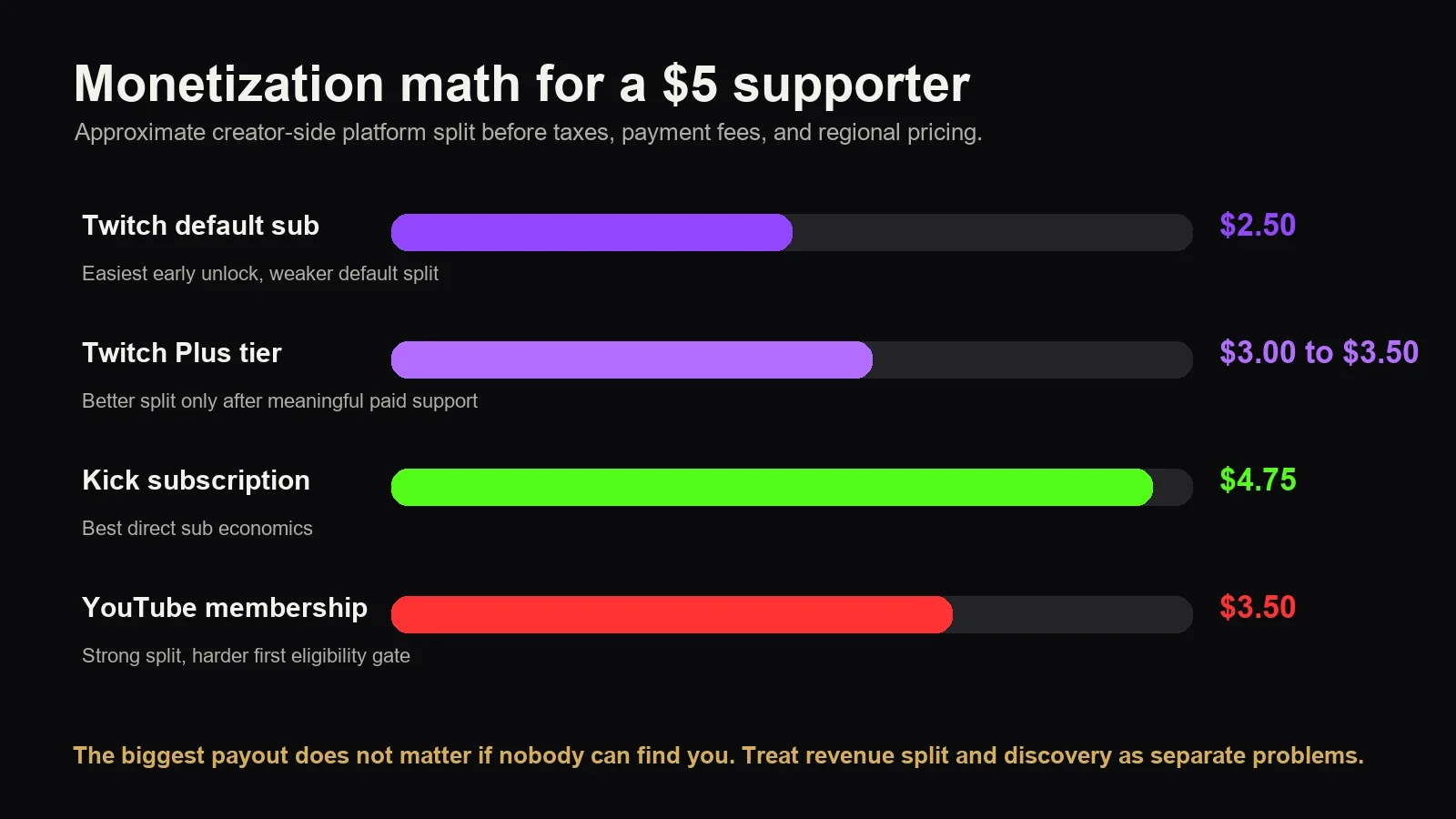
Kick has the cleanest direct monetization pitch. The Kick affiliate guide lists 75 followers and 5 total streamed hours as the current subscription eligibility path, and Kick's own revenue split documentation says streamers keep 95% of eligible subscription revenue. A $5 sub is meaningfully different when the creator side is around $4.75 instead of half the transaction.
That is not a small advantage. For a streamer with 20 paying supporters, the difference between a 50% split and a 95% split can be rent-money relevant. Kick understands that creator economics are part of recruitment. It is offering the thing small streamers can immediately understand: if your community supports you, you keep more of it.
Twitch is more complicated. The current Twitch Affiliate Program FAQ lists 25 followers, 4 hours streamed, 4 different stream days, and 3 average viewers on 4 different days. That is reachable for a small creator with consistency and a few friends who actually show up. Affiliate unlocks subs, Bits, ads, emotes, and channel points. It gives you the familiar Twitch monetization toolkit early.
The catch is the split. Unless you qualify for Twitch's Plus Program, most small creators should treat Twitch subscriptions as the weakest direct sub economics of the three. Plus improves the equation to 60/40 or 70/30, but the qualification path requires sustained paid recurring support: 100 Plus Points for Level 1 or 300 Plus Points for Level 2 across 3 consecutive months. That is not an early-stage feature. That is a retention reward for channels that are already moving real paid community volume.
YouTube has the slowest-feeling start but the strongest long-term monetization stack. The YouTube Partner Program full ad-revenue path still requires 1,000 subscribers with either 4,000 valid public watch hours in the last 12 months or 10 million valid public Shorts views in 90 days. YouTube also has an earlier fan-funding path, described by the YouTube Blog, at 500 subscribers, 3 public uploads in 90 days, and either 3,000 watch hours or 3 million Shorts views.
YouTube's upside is that monetization is not tied only to the live moment. A livestream can become a VOD. A VOD can become a search result. A clip can become a Short. A tutorial, review, highlight, or opinion piece can earn long after the stream ends. YouTube also gives creators 70% of confirmed membership revenue and 70% of confirmed Supers revenue after applicable deductions, according to YouTube's memberships and Super Chat help pages.
The money verdict is straightforward: Kick is best per supporter, Twitch is easiest to understand and unlock early, and YouTube is best if you will turn live content into a library.
Which streaming platform gives new creators the most visibility?
Visibility is where most small streamers lie to themselves.
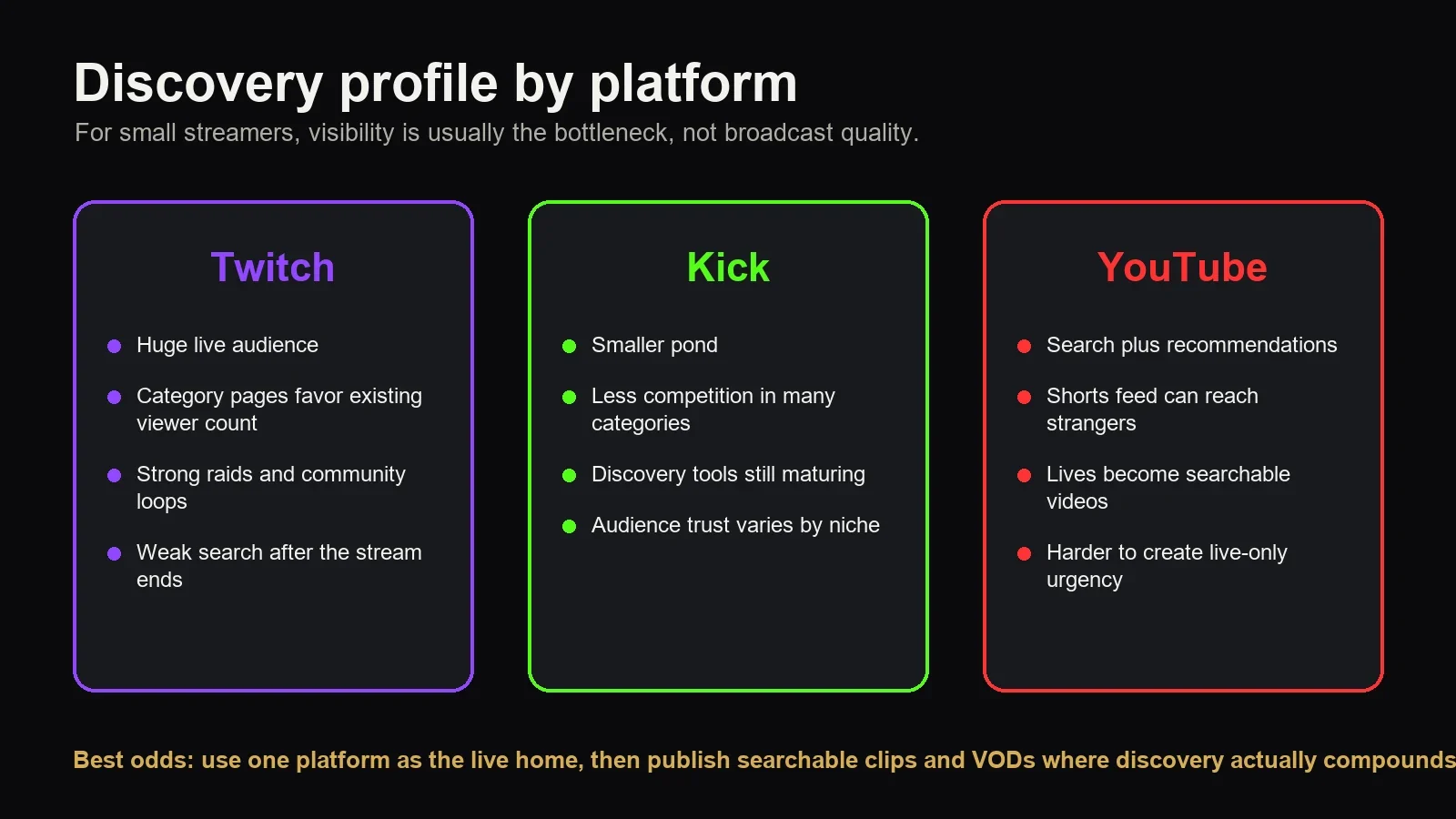
Twitch has the largest live-native gaming culture, but its browse experience still rewards channels that already have viewers. If a category is sorted by viewer count, the rich get richer. The top channels stay visible. Mid-sized channels get some overflow. Zero-to-five viewer channels sit where almost nobody scrolls.
Twitch does have discovery tools: raids, recommendations, front-page placements, clips, categories, tags, and shared community behavior. The problem is that most of those tools work best after you already have momentum. A raid helps if someone chooses you. Clips help if somebody clips and shares. Tags help only after a viewer reaches the browse surface. For the average new streamer, Twitch is excellent at keeping a live community active and poor at creating that community from scratch.
Kick has the opposite tradeoff. The audience is smaller, but many categories are less saturated. That means a small streamer can sometimes sit higher in a category with fewer concurrent viewers than they would need on Twitch. If you stream a game where Twitch has 300 channels live and Kick has 18, the math is obvious.
But smaller ponds have smaller fish traffic. Kick's discovery advantage is not that its algorithm is magically better. It is that there are fewer bodies in the way. That can matter early. It can also cap your upside if your niche does not have enough viewers on Kick yet.
YouTube is the visibility outlier because it is not only a live platform. It is a search engine, recommendation engine, Shorts platform, video archive, and subscription feed wrapped into one account. That makes it messier for live creators, but it gives YouTube a structural discovery advantage. A viewer can find you through a Short, a guide, a VOD chapter, a search result, a recommended video, a live stream, or a community post.
The Streamlabs and Stream Hatchet Q4 2025 report shows the platform reality clearly: Twitch still generated far more gaming live watch time than Kick or YouTube Gaming in that quarter, but Twitch also faced year-over-year viewership decline while YouTube Gaming remained relatively stable and Kick settled after rapid growth. In plain English, Twitch is still big, YouTube is structurally durable, and Kick is now real enough to matter but volatile enough to watch carefully.
For growth from zero, YouTube has the best discovery machinery. Twitch has the strongest live audience culture. Kick gives you the best chance to be visible inside a smaller category.
Where does viewer interaction feel most native?
Viewer interaction is not just chat messages. It is the whole ritual: emotes, raids, channel points, gifted subs, inside jokes, mods, alerts, clips, community nights, and the expectation that viewers are part of the show.
Twitch is still the best at that. The platform trained viewers to talk. Twitch chat has its own language, and that matters. A new viewer who lands on Twitch understands the basic behavior immediately: follow, chat, emote, sub, clip, raid. The social muscle memory is built in.
That is Twitch's strongest argument. Even when discovery is weak and revenue split complaints are fair, the live-room feeling is hard to copy. Twitch is where many gaming viewers still expect live gaming culture to happen.
Kick copies much of that live behavior, which is both a strength and a limitation. If you know Twitch, Kick feels familiar quickly. Chat, subs, gifted subs, emotes, categories, and streamer dashboards are not alien. That lowers the creator learning curve and makes migration less painful for communities that already know live streaming.
The viewer-side issue is trust and habit. Some viewers still see Kick as less established, more chaotic, or more strongly associated with gambling-adjacent creator culture and high-profile contract moves. That does not mean every Kick channel has that vibe. It does mean you may have to work harder to convince certain viewers, sponsors, or community members that your channel belongs there.
YouTube has improved live interaction significantly, especially with Live Control Room, polls, pinned messages, memberships, Super Chat, Super Stickers, redirects, and live chat replay. The interaction tools are real. They are just sitting inside a platform where many users are trained to watch passively.
On YouTube, a viewer might find your video through search, watch eight minutes, subscribe, and never type a word. That is still valuable. It is just not the same as a Twitch viewer who hangs out for three hours and becomes part of the room.
If your content depends on constant back-and-forth with chat, Twitch is still the strongest default. If your content works as a show that can be watched live or later, YouTube gets much more attractive. If your community already likes live chat and wants better direct support economics, Kick can work.
What are Twitch's pros and cons?
Twitch's biggest pro is cultural fit. Gaming streams feel natural there. Viewers understand the language. Raids matter. Category browsing exists. Chat culture is mature. Third-party tools are deep. OBS integrations, alerts, bots, overlays, moderation tools, emote systems, and analytics are all built around Twitch first or support it well.
Twitch also gives small creators a reachable first monetization milestone. The current Affiliate path is much lighter than older 50-follower and 7-day versions people still repeat. If you are organized, personable, and willing to invite friends into your first few streams, Affiliate is realistic.
The cons are just as real. Twitch discovery is structurally hostile to new channels in crowded categories. Pre-roll ads can hurt first impressions once you monetize. The default subscription economics are weaker than Kick and usually weaker than YouTube fan funding. The audience is large, but it is not evenly distributed. A million people can be watching Twitch while nobody sees you.
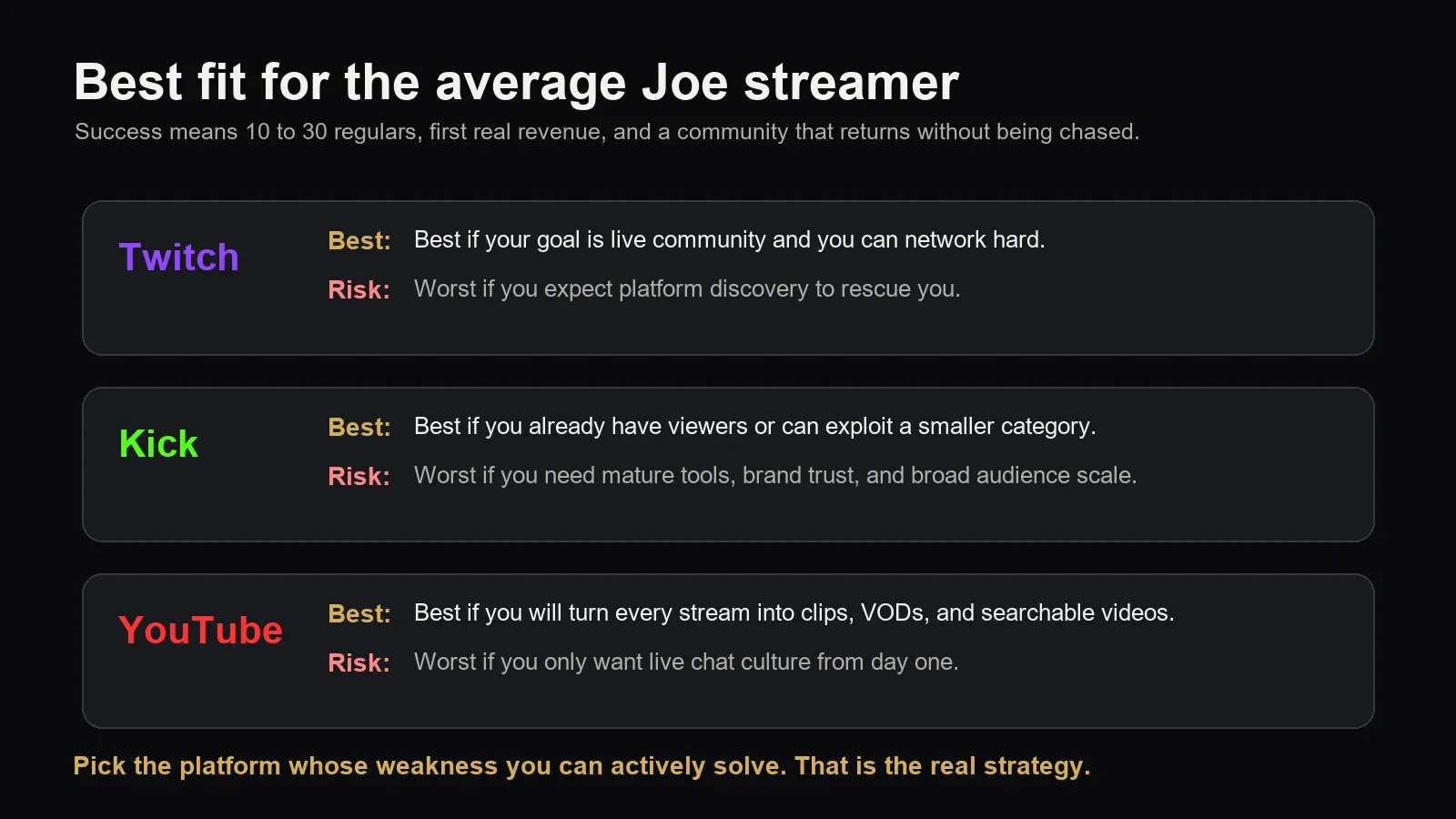
Twitch is best for streamers who want live community first and are willing to do off-platform growth work. It is worst for streamers who expect Twitch itself to promote them.
What are Kick's pros and cons?
Kick's biggest pro is simple: you keep more of the money your viewers spend. The 95/5 split is the most creator-friendly direct subscription pitch in mainstream live streaming. Affiliate requirements are also low enough that a motivated creator can reach monetization quickly.
Kick's second pro is category visibility. A small streamer can sometimes get seen faster because there are fewer live competitors. If you are early in a niche that has actual Kick viewers, the platform can give you room Twitch will not.
The cons are maturity and perception. Kick is younger. Tooling is improving, but the ecosystem is not as deep as Twitch. Brand safety questions are more common. Some viewers do not have a Kick account and will not make one casually. Some communities will follow a creator there, but strangers may need more convincing.
Kick is best for creators who already have a tight community, stream in under-served categories, or want direct supporter revenue to matter quickly. It is worst for creators who need the biggest possible addressable audience and a polished sponsor-friendly environment from day one.
What are YouTube's pros and cons?
YouTube's biggest pro is discovery that compounds. A Twitch stream mostly dies when the stream ends unless you export it elsewhere. A YouTube stream can become a searchable VOD, feed future recommendations, generate clips, build watch hours, and support a channel library that keeps working while you are offline.
That changes the job. You are not only a streamer on YouTube. You are a channel operator. Titles matter. Thumbnails matter. Descriptions matter. Chapters matter. Shorts matter. Upload cadence matters. If you hate that work, YouTube will feel heavier than Twitch.
The monetization stack is strong once you qualify. Ads, memberships, Supers, Shopping, Shorts, long-form, live, and VOD all live under one roof. YouTube also gives you cleaner paths for evergreen content: tutorials, reviews, build guides, patch reactions, tier lists, community updates, and stream highlights.
The cons are live culture and early monetization friction. YouTube viewers are not always trained to participate in chat. Live discovery can feel inconsistent. The 500-subscriber early fan-funding threshold is harder than Twitch Affiliate or Kick Affiliate for many brand-new streamers, and full ad monetization is harder still.
YouTube is best for creators willing to package their live work into searchable content. It is worst for creators who only want to hit Go Live, talk to chat, and never think about thumbnails again.
Where does the average streamer have the best chance?
Define success honestly before you pick the platform. If success means becoming a full-time streamer, all three platforms are long shots. If success means building 10 to 30 regular viewers, earning the first $100, and having a community that returns without being begged, the path is much more realistic.
For the average person starting from zero, Twitch is the easiest place to understand and the hardest place to be discovered. Kick is the easiest place to monetize per supporter and the riskiest place to depend on platform momentum. YouTube is the hardest place to operate casually and the best place to build durable discovery.
The highest-probability path is not picking one platform and pretending the others do not exist. It is choosing a live home and building a discovery engine around it.
If your live show is chat-heavy, community-driven, and personality-first, Twitch should probably be the home. But your clips, Shorts, and VOD cuts need to live on YouTube.
If your audience is already loyal and willing to move, Kick is worth serious consideration. But do not confuse a better split with a better funnel. You still need discovery.
If you are starting from nothing and are willing to edit, title, thumbnail, clip, and publish consistently, YouTube gives you the best chance to be found by strangers. It is slower emotionally because live chat may be quieter at first, but the work compounds better.
What is the practical recommendation?
Pick your live platform based on the weakness you can solve.
Choose Twitch if you can solve discovery. That means networking, raids, Discord community work, YouTube Shorts, TikTok, Instagram Reels, and searchable clips. Twitch will not hand you traffic. You have to bring traffic back to Twitch.
Choose Kick if you can solve trust and audience size. That means clear branding, consistent schedule, strong moderation, and enough off-platform reach to bring people into a smaller ecosystem. Kick will pay better per supporter, but you still have to create the supporters.
Choose YouTube if you can solve production discipline. That means treating every stream as raw material for titles, thumbnails, Shorts, VODs, chapters, and searchable videos. YouTube will reward packaging better than any other live platform, but it will punish lazy uploads and vague positioning.
Multistreaming can make sense if your setup and chat management can handle it, and Twitch's current simulcasting guidelines allow broader simulcasting than the old exclusivity era. But multistreaming is not a growth strategy by itself. Broadcasting to three empty rooms is still broadcasting to empty rooms. Use it only if you can manage chat cleanly and keep one community identity.
The strongest practical setup for most small streamers is this:
Live home: Twitch or Kick, depending on whether you value culture or creator split more.
Discovery home: YouTube, because search, Shorts, and VODs compound.
Community home: Discord, because no streaming platform should own your entire audience relationship.
Clip pipeline: Shorts, TikTok, and Reels, posted consistently with platform-specific titles.
That is not more glamorous than "go live and grind." It just works better.
What is the honest verdict?
Twitch is still the best live room. Kick is still the best direct subscription math. YouTube is still the best discovery engine.
For the average Joe streamer, YouTube gives the best long-term odds if you are willing to do the work around the stream. Twitch gives the best live culture if you can bring people in from elsewhere. Kick gives the best early monetization upside if you can build trust and pull viewers into a smaller platform.
Do not choose based on where famous creators signed contracts. Their problem is audience migration. Your problem is audience creation.
If you are starting today, build the channel like this: stream where the live experience fits your personality, publish where strangers can find you, and never let one platform become the only place your audience knows you exist. The platform is not the business. The audience is.
Related reading
Written by
ApexInterfectum
Co-Founder, PUG Empire | Army Veteran | Full Stack Developer
ApexInterfectum is an Army veteran and co-founder of PUG Empire, a competitive gaming community built on coordinated team play and continuous improvement. He brings a full-stack development background to community tooling and content infrastructure, and serves as technical subject matter expert across the Dirty Rice platform. His writing covers the systems and strategies behind sustainable content creation, competitive growth, and modern streaming workflows.
Community Rating
Rate this article:
Intel & Reactions - (0)
Sign in with Discord to join the conversation.
No comments yet. Be the first to drop some intel.